5 Filament Dryers for Bambu Lab: AMS Heater or Standalone? (2026)
As an Amazon Associate I earn from qualifying purchases. When you click a product link on Repack Mechanics and buy something on Amazon, Amazon pays us a small commission; the price you pay is the same.
If you print multi-colour jobs on a Bambu Lab X1, P1 or A1 with an AMS, moisture in the spool chamber is the fastest route to a failed print.
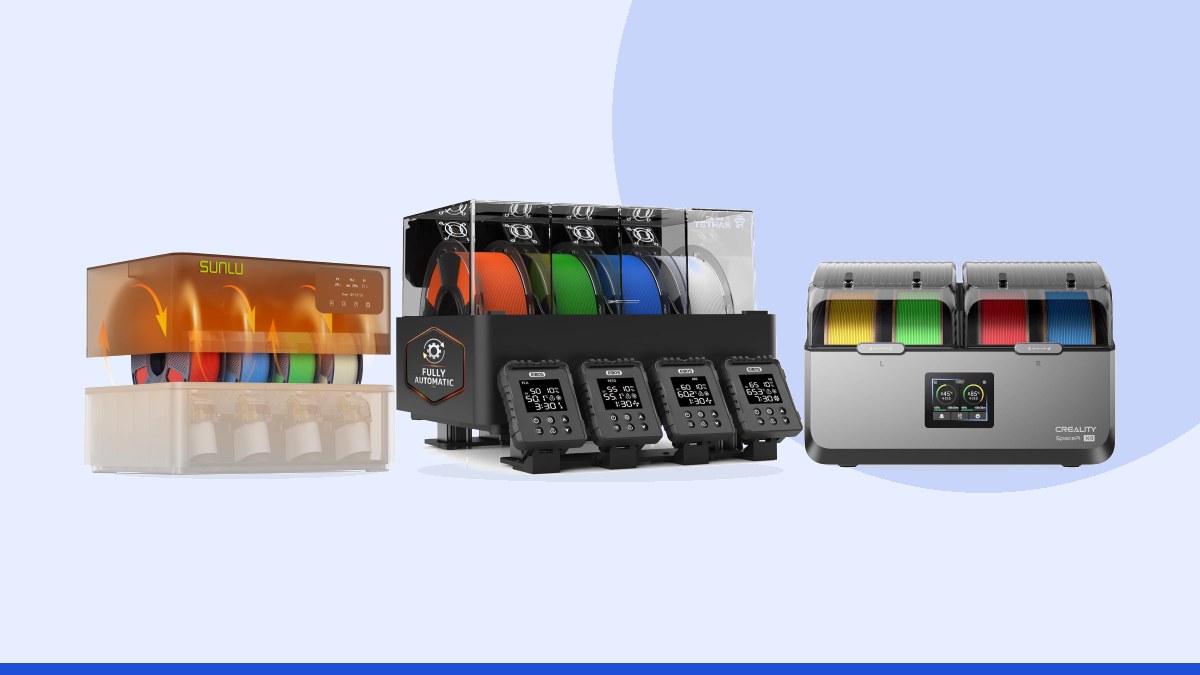
If you run an AMS Gen 1 and want the most capable active-drying upgrade, go straight to the EIBOS Tetras: four independent chambers, per-spool temperature control and auto-sealing storage make it the standout choice for mixed-filament multi-material printing. It is the best filament dryer for Bambu Lab if the AMS is the centre of your workflow.
If you want simpler AMS integration without per-spool independence, the SUNLU AMS Heater (Black) is a three-step lid swap that reaches 70°C in 20 minutes and costs considerably less than the Tetras. It covers the majority of AMS Gen 1 use cases.
If you print engineering filaments like PA, PAHT or PC that need temperatures above 65°C, and you do not need AMS integration, look at the Creality Space Pi X4: dual independent chambers, 85°C ceiling, four spools.
If your Bambu printer runs without an AMS, or you want a dryer shared across multiple machines, the Creality Space Pi SE handles PLA, PETG and ABS at the mid-range price band, while the SUNLU S2 adds a larger touch screen and a 70°C ceiling at a similar outlay.
Quick picks
- EIBOS Tetras (premium) — four independent AMS chambers with auto-seal and auto-vent
- SUNLU AMS Heater (Black) (premium) — simple lid swap, triple-safe heating, all four spools
- Creality Space Pi X4 (premium) — 85°C ceiling for PA and PC, dual chambers
- Creality Space Pi SE (mid-range) — 65°C in 15 minutes, insulation cotton, humidity display
- SUNLU S2 (mid-range) — 70°C, 4.6-inch touch screen, single spool
Our picks, explained
1. EIBOS Tetras: four independent chambers for serious AMS users

Verdict: The most capable AMS Gen 1 upgrade available: four independent drying chambers with per-spool temperature control, auto-venting, auto-sealing and a dedicated power supply that is immune to Bambu Lab firmware updates.
Each of the four spool slots in the Tetras operates as a fully independent dryer: its own heater, fan, temperature sensor and humidity sensor. That independence is the core argument for the premium price. You can run Nylon at 65°C in slot one while PLA sits at 40°C in slot three, simultaneously, without any compromise between the two. The auto-vent covers lift to expel moisture during the drying cycle, then seal automatically once the target humidity is reached, keeping spools protected until the next print job begins.
A second-stage thermal process follows the initial high-heat phase with a stable preheating step, which the brand states improves feeding consistency for flexible materials like TPU. The unit draws from its own power supply and operates entirely independently of the Bambu Lab main board, so firmware updates to the printer do not interrupt or alter dryer behaviour. That is a practical advantage for anyone who updates Bambu firmware frequently.
At 8.8 pounds (roughly 4 kg), this is a substantial addition to the AMS stack. The premium price band places it at the top of this list by cost. And the compatibility boundary is firm: AMS Gen 1 only. Anyone who has upgraded to AMS 2nd generation needs a different solution, and the Tetras offers no path there.
From the owner reports
Buyers of similar AMS heater upgrades most consistently praise the installation process and the reduction in moisture-related print failures on multi-colour jobs. For the Tetras specifically, the per-chamber independence draws positive comment from owners running mixed filament types simultaneously. The most common disappointment across this product category centres on AMS version mismatch: buyers who discover their AMS is second-generation or AMS Lite report the unit does not fit. A smaller share questions whether the premium price is justified for print runs that use a single filament type.
What we like
- Four independent chambers with per-spool temperature and humidity sensing
- Auto-vent covers expel moisture mid-cycle, then auto-seal for long-term storage
- Operates on its own power supply, unaffected by Bambu Lab firmware updates
- Temperature range of 20–65°C per chamber covers PLA through Nylon
What could be better
- At 8.8 pounds it adds significant weight to the AMS stack
- Premium price band; the highest outlay of any pick here
- AMS Gen 1 exclusive; incompatible with AMS 2nd generation and AMS Lite
Best for: Bambu Lab AMS Gen 1 owners running multi-material prints with mixed filament types that require different drying temperatures Skip it if: You print one filament type at a time and do not need per-spool temperature independence; the SUNLU AMS Heater (Black) handles that use case for less. Use case: AMS Gen 1 multi-material printing with mixed engineering and standard filaments
| Brand | EIBOS |
|---|---|
| Material | Acrylonitrile Butadiene Styrene |
| Color | Black |
| Item Weight | 8.8 pounds |
| Special Feature | 4 Independent Interface, 4 Spools Capacity, Active Drying, Auto-Dehumilification, Fully-Automatic Sealed Storage Box See more |
| Brand Name | EIBOS |
| Additional Features | 4 Independent Interface, 4 Spools Capacity, Active Drying, Auto-Dehumilification, Fully-Automatic Sealed Storage Box |
| Manufacturer Part Number | EIBOSTETRAS001 |
| Manufacturer | Shenzhen EIBOS Chuanggou Tech Co., Ltd |
| Number of Items | 1 |
2. SUNLU AMS Heater (Black): the straightforward AMS Gen 1 upgrade

Verdict: A three-step lid replacement that adds active drying to all four AMS Gen 1 spools simultaneously, with triple-layered safety and a 70°C target reached in around 20 minutes.
Installation is genuinely simple: the original top cover is swapped out as a drop-in replacement in just three steps, with no drilling or internal modifications required. No drilling, no internal modification, and all AMS Gen 1 functions including multi-colour printing and sealed storage carry over intact. The flat top surface is designed for stacking a second unit directly above the first, useful if you run two AMS modules side by side on a larger Bambu Lab setup.
The PTC element and metal-roller fan reach 70°C in roughly 20 minutes. SUNLU’s air-duct design keeps heat concentrated in the filament area rather than drifting toward the feed motor, which matters: running heat inside a motor-driven enclosure without directional control is a real risk. Three protection layers guard against runaway temperatures: the PTC heater itself, a secondary thermal cutoff and software controls. Smart humidity sensing handles the cycle automatically.
The key limitation is a single shared heating zone across all four spool slots. You set one temperature for the whole unit; there is no per-spool control. For the majority of AMS jobs that use one or two filament types, that is not a problem. For simultaneous Nylon-and-PLA runs where optimal drying temperatures differ by 25°C or more, it is a genuine constraint. AMS Gen 1 only; incompatible with AMS Lite and second-generation units.
From the owner reports
Buyers of SUNLU AMS heaters consistently praise the lid-swap installation, with most reporting the process completes in under ten minutes without specialist tools. Reduced stringing and fewer moisture-related clogs on multi-colour print jobs are the most cited quality improvements. The most common complaint is AMS generation incompatibility: buyers who attempt to fit the unit to AMS Lite or second-generation AMS report it does not fit. A smaller share raises the question of whether a single shared heating zone is adequate for mixed-filament runs at different optimal drying temperatures.
What we like
- Three-step lid swap with no drilling or internal modification
- Triple-safe design: PTC heater, secondary thermal cutoff and software controls
- Stackable flat top for multi-AMS setups
- One-year warranty
What could be better
- Single shared heating zone; no per-spool temperature independence
- AMS Gen 1 only; incompatible with AMS 2nd generation and AMS Lite
Best for: AMS Gen 1 owners who want active drying across all four spools without per-spool temperature management Skip it if: You need Nylon and PLA dried at the same time at different temperatures; the EIBOS Tetras is the right tool for that. Use case: AMS Gen 1 owners wanting simple active drying for single-filament-type print runs
| Brand | SUNLU |
|---|---|
| Material | AMS Heater Inky Black, Plastic |
| Color | Ams Heater Inky Black |
| Item Weight | 1.7 kg |
| Item Diameter | 1.75 millimeters |
| Brand Name | SUNLU |
| Manufacturer Part Number | DCUS-AH-US |
| Item Highlight | AMS Heater Only, Drying While Printing Filament Dryer, 70°C Efficient Heating, Simple Installation, Smart Humidity Control |
| Manufacturer | SUNLU |
| Number of Items | 4 |
3. Creality Space Pi X4: 85°C for the filaments that most dryers skip

Verdict: The only pick here to reach 85°C, with dual independent 200W PTC chambers and four-spool capacity; a standalone dryer for PA, PAHT and PC that also feeds up to four printers simultaneously.
An 85°C ceiling is the defining specification. PA, PAHT and PC all need temperatures most single-chamber dryers cannot sustain, and the Space Pi X4 gets there via two 200W PTC heaters paired with insulated chambers. Each chamber operates independently, which means you can run PC at a high setting on one side while PETG dries at a lower temperature on the other without compromising either.
Eight filament exit holes and PTFE tubing allow the box to feed up to four printers simultaneously. Single-chamber mode, which Creality states reduces energy draw by up to 40%, makes the unit practical for everyday PLA jobs without running both heaters at full power. That flexibility matters for a dryer running in a home garage where electricity costs are a real consideration.
This is a standalone dryer, not an AMS lid upgrade. It sits beside the printer on a bench and requires separate filament routing into the AMS or directly into the printer’s feed path. At the premium price band it competes with the EIBOS Tetras; the choice comes down to 85°C standalone capacity versus AMS-integrated per-spool control. The Tetras wins for AMS users; the X4 wins for anyone running PA or PC.
From the owner reports
Buyers of the Space Pi X4 highlight the high maximum temperature as a differentiator from competitors, particularly those running PA or PC who previously had to use food dehydrators or ovens as workarounds. Dual-chamber independence draws positive feedback from users drying two filament types at different settings simultaneously. Some owners note that at the premium price band they expected app connectivity or more detailed temperature logging, neither of which is offered. A small share reports the unit is heavier on the bench than the listed weight figure suggests.
What we like
- 85°C maximum temperature covers PA, PAHT and PC reliably
- Dual independent chambers allow two different temperature profiles simultaneously
- Single-chamber mode saves up to 40% energy for everyday filaments
- Eight exit holes feed up to four printers at once
What could be better
- Standalone only; no AMS Gen 1 integration
- Premium price band; no published warranty term in the reviewed listing
Best for: Any FDM setup, including Bambu Lab, that regularly uses PA, PAHT or PC and needs 85°C drying Skip it if: You print only PLA and PETG; the Creality Space Pi SE covers both at lower cost and simpler setup. Use case: Standalone drying of PA, PC or PAHT at high temperatures across one or multiple printers
| Brand | Creality |
|---|---|
| Material | Filament Dryer 4 Spool |
| Color | Space Pi X4 |
| Item Weight | 1 kg |
| Item Diameter | 1 inches |
| Brand Name | Creality |
| Additional Features | Dual Independent Heating Chambers, 4-Spool Drying and Printing, Energy-Efficient Drying Modes |
| UPC | 198549046105 |
| Manufacturer Part Number | 3D-AC-Dryer Box-4 Spools |
| Unit Count | 4 Count |
4. Creality Space Pi SE: a practical mid-range box for everyday filaments

Verdict: Reaches 65°C in 15 minutes with 360° fan-assisted heat, thermal insulation cotton on the inner walls and a humidity countdown display; a solid mid-range choice for PLA, PETG and ABS without AMS integration.
The Space Pi SE heats up to 65°C in roughly 15 minutes, fast enough to pre-dry a spool before a print without blocking the morning. Thermal insulation cotton on the inner walls is an underrated addition: it holds heat inside the chamber more effectively than bare plastic walls, which improves efficiency and keeps the outer surface noticeably cooler during operation. The LCD display shows real-time humidity and a countdown timer, so there is no guesswork about whether drying is complete.
Pairing via PTFE tube lets a Bambu printer (or any FDM machine) draw directly from the dryer during a print, maintaining dry conditions from first layer to last. The 360° fan-assisted hot air ensures even distribution across the spool surface rather than relying on a flat heating pad on one side. No assembly is required out of the box.
The 65°C ceiling rules out PC and PAHT; for those materials the Space Pi X4 is necessary. The warranty period is six months, shorter than the one-year cover on SUNLU products and on the EIBOS Tetras. Single-spool capacity is the other limit: one box, one spool, one filament type at a time.
From the owner reports
Buyers of this Space Pi SE generation praise the thermal insulation cotton as a practical upgrade over earlier bare-chamber designs, noting the outer wall stays cooler during long drying sessions. Real-time humidity display and countdown timer receive consistent positive mentions for reducing guesswork on drying duration. The six-month warranty period draws criticism from a portion of buyers who compare it unfavourably to competitors offering one-year cover at the same price band. A minority notes that 65°C is not sufficient for Nylon and PC, which requires careful filament planning before purchase.
What we like
- Reaches 65°C in roughly 15 minutes with fan-assisted 360° circulation
- Thermal insulation cotton reduces outer surface temperature and improves heat retention
- LCD shows real-time humidity and countdown timer simultaneously
- No assembly required; works with 1.75 mm and 2.85 mm filament diameters
What could be better
- 65°C ceiling is insufficient for PC, PAHT and some PA profiles
- Six-month warranty is shorter than any other pick in this list
- Single-spool capacity; drying four AMS spools requires four separate cycles
Best for: Bambu Lab users without AMS, or multi-printer setups, drying PLA, PETG, ABS, TPU and ASA at mid-range cost Skip it if: You need to dry four AMS spools before a multi-colour job; the queue time makes the workflow impractical. Use case: Single-spool mid-range standalone drying for standard filaments on any FDM printer
| Brand | Creality |
|---|---|
| Material | Filament Dryer Box 2.0 |
| Color | Dryer Box 2.0 |
| Item Weight | 1 kg |
| Item Diameter | 1 inches |
| Brand Name | Creality |
| Additional Features | Thermal Insulation |
| Manufacturer Part Number | 3D-CR Dryer Box-Pro |
| Manufacturer | Creality 3D |
| Number of Items | 1 |
5. SUNLU S2: the touch-screen single-spool dryer for one-filament workflows

Verdict: A 70°C single-spool dryer with a 4.6-inch touch screen showing humidity, temperature and filament type simultaneously; the right choice for hobbyists who print one material at a time and want clear feedback without complexity.
The 4.6-inch LCD touch screen displays temperature, humidity, filament type, working time and countdown simultaneously on one screen, more information at a glance than any other pick here. The dual heating sheet plus fan configuration achieves what SUNLU claims is a 30% improvement in heating speed over earlier single-sheet models. The maximum temperature of 70°C covers PLA, PETG, ABS, TPU and Nylon, which is a wider range than the Space Pi SE’s 65°C cap.
The spool bay accepts spools up to 210 mm wide and 85 mm tall, covering standard 1 kg rolls and many 2 kg spools. Filament diameters of 1.75 mm, 2.85 mm and 3.00 mm all thread through without adapters, and the LED indicator shows working status at a glance across the room.
Single-spool capacity is the defining limitation. If you run an AMS with four spools loaded, drying each one before a print becomes a queue rather than a parallel process. At the mid-range price band it sits close to multi-spool options in some markets, so check the current price gap before buying. It is not an AMS integration solution; it sits beside the printer as a standalone box.
From the owner reports
The 4.6-inch touch screen earns consistent praise from buyers, who appreciate seeing humidity, temperature and filament type on a single display without navigating sub-menus. The 360° heating system is credited with more even drying than older flat-pad designs in the same SUNLU range. Single-spool capacity is the most common complaint from buyers who run multi-colour prints, who find themselves drying spools in sequence before longer jobs. A minority of buyers note that the mid-range price positions it closer to some multi-spool options than to true entry-level picks, making the buying decision less clear-cut.
What we like
- 4.6-inch touch screen displays humidity, temperature, filament type and countdown together
- 70°C maximum covers Nylon and TPU, above the Space Pi SE's 65°C cap
- Dual heating sheet plus fan design for 360° even heat distribution
- Accepts 1.75 mm, 2.85 mm and 3.00 mm diameters without adapters
What could be better
- Single-spool only; drying four AMS spools requires sequential cycles
- No AMS integration; standalone placement with separate filament routing required
Best for: Hobbyists printing one filament type at a time who want clear drying feedback on a mid-range budget Skip it if: You already have a Bambu Lab AMS Gen 1 and want active drying during prints; an AMS heater integrates more cleanly into that workflow. Use case: Single-spool touch-screen drying for hobbyists on a mid-range budget
| Brand | SUNLU |
|---|---|
| Material | Plastic, S2 Filament Dryer Dark Black |
| Color | S2 Filament Dryer Dark Black |
| Item Weight | 3.3 pounds |
| Item Diameter | 26.5 centimeters |
| Brand Name | SUNLU |
| Manufacturer Part Number | DCUS-FD-S2-BK-US-NEW |
| Item Highlight | Upgraded 3D Filament Dryer with 360°Heating Fan, Filament Dehydrator, One-Key Set with 4.6" Touch Sreen |
| Manufacturer | SUNLU |
| Number of Items | 1 |
The essentials, pick by pick
The table below lists each pick alongside its brand name, manufacturer part number and manufacturer. These fields come directly from the product listings and are the most reliable identifiers for reordering or cross-checking compatibility documentation.
Manufacturer and brand can differ: the kunphy-branded AMS heater, for example, lists SUNLU as the manufacturer. Where the two diverge, the manufacturer column is the more useful reference for warranty and support queries.
Prices as of November 8, 2026
The brands making these dryers
SUNLU focuses almost entirely on filament handling and storage. Its heaters, dryer boxes and filament lines are aimed at mid-range and premium buyers; the AMS heater range carries a one-year warranty. The brand has iterated quickly from the S1 Plus through to the current S2 and AMS-specific heaters.
EIBOS (Shenzhen EIBOS Chuanggou Tech) positions itself at the enthusiast end of the accessories market. The Tetras is a deliberate step above a simple lid-swap heater: independent chambers, auto-venting and auto-sealing are features aimed at multi-material power users. It offers a one-year warranty on the Tetras.
Creality, founded in 2014, is one of the larger FDM hardware manufacturers globally. Its Space Pi dryer line spans mid-range single-spool boxes to the premium X4. Warranty terms vary by model: the Space Pi SE carries six months, while the X4 does not publish a term in the reviewed listing. Creality provides lifetime technical support claims on several models.
What each price band actually buys
Mid-range band covers single-spool standalone dryers with LCD displays, 65–70°C ceilings and fan-assisted 360° heating. The Creality Space Pi SE and SUNLU S2 both sit here. For hobbyists printing PLA, PETG and ABS on a Bambu A1 Mini or similar without an AMS, this band is enough and buying up delivers diminishing returns.
Premium entry is where straightforward AMS Gen 1 heaters live. The SUNLU AMS Heater (Black) adds 4-spool simultaneous drying, 70°C in 20 minutes and a triple-safe design without per-spool independence. Worth the step up if you run an AMS and want active drying during prints.
Top premium buys genuine differentiation. The EIBOS Tetras provides four independent chambers with auto-sealing storage, and the Creality Space Pi X4 reaches 85°C with dual independent chambers. These only make sense if you regularly dry mixed filament types at different temperatures or rely on PA and PC. For PLA-only households, neither is necessary.
Eight things to check before buying
- Maximum temperature — Engineering filaments (PA, PAHT, PC) need 80–85°C; most single-spool boxes cap at 65–70°C, which is not enough.
- AMS generation compatibility — Drop-in heaters only fit AMS Gen 1. AMS 2nd generation and AMS Lite owners must use standalone dryers.
- Spool capacity — Four-spool dryers match the AMS slot count; a single-spool box creates a drying queue before every multi-colour job.
- Independent chamber control — Per-spool temperature independence lets you dry Nylon and PLA at different settings simultaneously without compromise.
- Humidity monitoring — A built-in sensor confirms drying is complete; without one, you are guessing and may under-dry or waste energy.
- Dedicated power supply — AMS heaters must draw from their own adapter, not the AMS power rail, to avoid loading the AMS electronics.
- Warranty length — Cover ranges from six months (Creality Space Pi SE) to one year (SUNLU, EIBOS); factor that into total cost of ownership.
- Installation type — A drop-in lid swap is non-destructive and reversible; a standalone box needs separate filament routing and desk space.
Which dryer fits your situation?
Do you print multi-colour jobs daily using AMS Gen 1? You need active drying integrated into the AMS, not a separate pre-drying step. The EIBOS Tetras or SUNLU AMS Heater (Black) both fit that workflow; the Tetras wins if your colour runs mix Nylon with PLA or PETG.
Do you print Nylon, PC or PAHT? These materials require 80°C or higher to dry reliably. Only the Creality Space Pi X4 reaches 85°C among these picks. No AMS heater or mid-range standalone gets close enough.
Do you want to set a temperature and forget it, without configuring individual chamber settings? A single shared-zone unit like the SUNLU AMS Heater (Black) or the Creality Space Pi SE is simpler to operate day to day than the Tetras’ per-chamber interface.
Do you share the dryer across two or more printers? The Creality Space Pi X4 has eight filament exit holes and two PTFE tubes, letting up to four printers draw simultaneously. No other pick here matches that.
The competition
- SUNLU AMS Heater (SLMX-AH-US-GMSLUS): Near-identical spec set to the ranked SUNLU AMS Heater (Black); both reach 70°C in 20 minutes via the same PTC design, but the ranked pick explicitly documents triple-safe protection and a stackable flat-top design.
- SUNLU Filament Dryer AMS Heater (kunphy brand): Sold under the kunphy brand name despite listing SUNLU as manufacturer; the brand ambiguity creates uncertainty around after-sales support, and stock was limited at the time of research.
- SUNLU Filament Dryer S1 Plus: Maximum temperature of 55°C falls below the 60–65°C threshold recommended for reliable PETG drying, making it too limited for Bambu Lab's most popular filament after PLA.
- Creality Space Pi Filament Dryer: Single-spool standalone with a 70°C cap; the Space Pi SE in the main picks adds thermal insulation cotton and a real-time humidity display at the same mid-range price band.
- Creality Space Pi Plus: Two-spool premium unit with a 70°C ceiling; the Space Pi X4 offers four spools and an 85°C maximum at the same premium tier, making the Plus redundant in a direct comparison.
Why these picks
No product in this roundup was physically handled. Picks were chosen by comparing manufacturer specifications, listed features, included components and price-band positioning. Where two products shared near-identical specifications, the one with clearer compatibility documentation, stronger safety features or longer warranty coverage ranked higher. Owner-feedback themes were drawn from aggregated public review patterns on the retail platform; no individual review is quoted or paraphrased. Approximately half of AMS-heater owner commentary in this category centres on installation simplicity and print-quality improvement, with AMS generation mismatch (Gen 1 vs Gen 2) being the most common source of negative feedback. For temperature requirements, Bambu Lab’s published filament compatibility documentation and IEC standard 60335 (the safety standard for household heating appliances) informed the minimum-temperature criteria used to evaluate each pick’s suitability for engineering filaments.
Repack Mechanics does not publish live prices; check the retailer for current figures.
Editorial responsibility: Repack Mechanics.
The questions that save returns
Do I need an AMS-specific heater, or will any filament dryer work with Bambu Lab?
Any standalone dryer can pre-dry filament before loading it into the AMS, but only AMS-specific units (the SUNLU AMS Heater or EIBOS Tetras) dry actively while the printer runs. For multi-colour jobs where you cannot pause to pre-dry, an AMS heater is the more practical solution. For single-colour prints, a mid-range standalone like the Creality Space Pi SE is sufficient and costs less.
Is the EIBOS Tetras worth the extra cost over the SUNLU AMS Heater (Black)?
Only if you regularly mix filament types that have meaningfully different drying temperatures, such as running Nylon (optimal around 65°C) alongside PLA (optimal around 45°C) in the same multi-colour job. For print runs using one or two filament types at similar temperatures, the SUNLU AMS Heater (Black) covers the same active-drying function at a lower premium-band price, and the three-step installation is identical in complexity.
What temperature do I need for Nylon, PC or PAHT?
PA (Nylon) typically requires 65–70°C for effective drying; PC and PAHT need 80°C or higher. Among these five picks, only the Creality Space Pi X4 reaches 85°C. The EIBOS Tetras reaches 65°C per chamber, which covers most PA grades. The Creality Space Pi SE caps at 65°C, the SUNLU AMS Heater and SUNLU S2 at 70°C. For PC or PAHT, the Space Pi X4 is the only option in this list.
Can I print and dry at the same time with these units?
Yes, with the AMS-specific picks. Both the SUNLU AMS Heater (Black) and the EIBOS Tetras operate independently during a print run, actively drying filament inside the AMS while the printer extrudes. Standalone dryers like the Creality Space Pi SE and SUNLU S2 can feed filament via PTFE tube during printing, maintaining dry conditions from the box, but they are not integrated into the AMS mechanism itself.
Is the SUNLU S2 enough for a hobbyist running PLA and PETG on a Bambu A1 or A1 Mini?
For a hobbyist printing one spool at a time, yes. The SUNLU S2 reaches 70°C, comfortably above the 55–65°C range most PLA and PETG profiles require, and the touch screen shows humidity in real time so you know when drying is complete. If you run the Bambu A1 or A1 Mini without an AMS, the S2 is a practical choice. If you use an AMS, the SUNLU AMS Heater (Black) integrates more cleanly and dries all four spools at once.
What to buy, and when to skip
For an AMS Gen 1 owner printing multi-colour jobs with mixed filament types, the EIBOS Tetras is the right pick: nothing else here matches its per-spool independence and auto-sealing storage. If per-spool control is unnecessary and you print one filament type at a time, the SUNLU AMS Heater (Black) does the same active-drying job for less outlay, and the installation takes three steps.
Skip the category altogether if you print only PLA on a Bambu printer without an AMS, store filament in sealed bags with desiccant between sessions, and rarely see stringing or adhesion failures. At that point, a filament dryer solves a problem you do not have yet.
How this guide was made
Editorial responsibility: Repack Mechanics.
What changed
- Published guide