Best Garage Parking Aids in 2026: 9 Picks for Every Setup
As an Amazon Associate I earn from qualifying purchases. When you click a product link on Repack Mechanics and buy something on Amazon, Amazon pays us a small commission; the price you pay is the same.
You pull forward in the dark, one hand already reaching for the door handle, with half a second of doubt about whether the bumper is a foot or an inch from the shelf.
The first thing to settle is mounting constraints. Ceiling-hung aids — lasers and tennis balls — give precise visual depth cues but require drilling into joists or drywall; floor-standing signs and mats need nothing above the door threshold, while wall sensors split the difference by mounting to the rear wall with adhesive strips or screws. Knowing which surfaces you can fix hardware to narrows the field immediately.
Second, decide whether you need the guidance to be active or passive. A floor mat provides a physical wheel stop at every speed with no power source; a laser or LED sign depends on electricity, a charged battery, or both, and fails silently if the power is out. For households where the garage circuit trips occasionally, battery backup is a practical requirement, not a luxury add-on.
Third, count the cars. A 2-pack LED stop-sign kit or a dual-laser unit earns its mid-range price in a two-car garage; for one bay, a single laser or single mat is the more precise choice and usually cheaper.
Fourth, check your tenancy. Peel-and-stick mats and tool-free floor signs are the only options renters can use without risk to a security deposit, and they come off cleanly when the lease ends. These four criteria drive every ranking on this page.
In this guide
Best Overall — Fosmon dual laser
- Dual beams cover two stalls from one ceiling unit
- 75-degree widened angle, 33 ft motion detection
- Battery backup keeps guidance live through power cuts
Best for single-car garages — MAXSA 37310 single laser
- Class IIIA laser with 130-degree motion detection
- Both screw and adhesive mounting options included
- Long-established design with 9V AC and battery-backup option
Best LED floor stop sign — Securityman LED stop sign
- 7-inch sign face — largest LED sign in this comparison
- Adjustable to 55 inches for SUVs and full-size trucks
- Spring-connected pole absorbs contact; batteries already included
The Garage Parking Aids worth buying, in detail
Fosmon dual laser — two-stall coverage from one ceiling unit

Why we picked it: The widened 75-degree dual laser covers two parking stalls from a single ceiling mount, and the motion-activated 9V battery backup keeps guidance live through power cuts. For the price band, two-car coverage with independent beam control is genuinely hard to match.
| Add to Cart | Add to Cart |
|---|---|
| 4.1 out of 5 stars 3,116 | 4.6 out of 5 stars 441 |
| $21.99 $ 21 . 99 | $19.98 $ 19 . 98 |
| Helps guide you to park up to 2 cars | Helps protect your cars and walls |
| Garage | Garage |
| Gray | Black |
| Manufacturer | Fosmon |
| Brand | Fosmon |
| Item Weight | 8.8 ounces |
| Product Dimensions | 4.4 x 3.9 x 1.9 inches |
The 9V battery backup is the detail that separates this from simpler plug-only ceiling units — a tripped breaker or blown fuse mid-pull won’t leave you guessing at distance in the dark, and the backup is not a hidden premium, it is listed as standard. Fosmon’s updated angle widens the spread to 75 degrees, meaning both beams clear most two-stall layouts without repositioning the unit on the ceiling. Motion detection fires at up to 33 feet, so the lasers are already active before the car’s nose clears the door threshold, then cut out 30 seconds after movement stops; the toggle on the side lets you deactivate one beam when only one bay is in use. Each laser is adjustable 360 degrees, so you aim one at the steering column and the other at a dashboard reference of your choice. That adjustability is also the first drawback: getting two beams dialled in simultaneously takes patience, and any shift of the ceiling mount — from vibration or a renovation — means starting over. The second limitation is structural: this is purely visual guidance with no physical stop, so a family member who ignores the dot will park wherever they please. Installation requires drilling into joists or drywall, which makes it a non-starter for renters and for garages with finished drop ceilings. The backup battery is not included in the box, which is a real omission at this price.
Owner feedback patterns
Buyers of ceiling-mounted laser aids broadly praise the precision once the beam is correctly aimed at a consistent dashboard reference point; the friction they describe most often centres on the initial calibration process, particularly keeping both beams aligned after any movement of the mounting hardware. The absent backup battery draws predictable repeat comment across the category.
Who it’s for: Two-car households who want ceiling-mounted, motion-activated guidance with power-cut resilience Skip it if: Skip if you cannot drill into the ceiling or if any household member reliably ignores visual cues in favour of feel. Use case: Two-car garage needing ceiling-mounted motion-activated guidance
MAXSA 37310 single laser — a long-proven one-bay ceiling guide
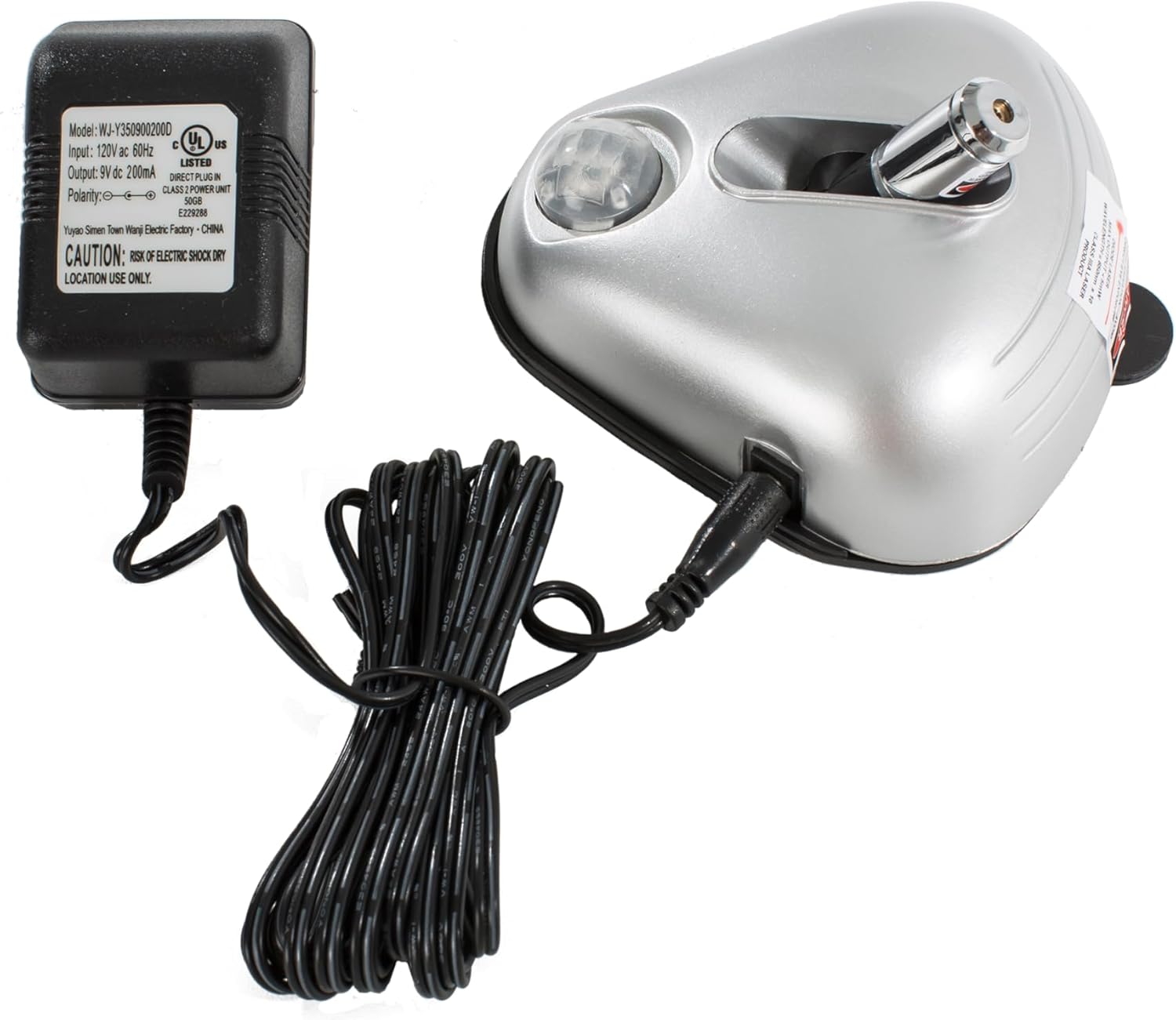
Why we picked it: A single Class IIIA red laser with 130-degree motion detection covers one bay from the ceiling, and the design has been in continuous production since 2001 — a track record no rival in this comparison can match. Both screw and adhesive mounting options are included, lowering the commitment to install.
| Add to Cart | Add to Cart |
|---|---|
| 4.3 out of 5 stars 1,153 | 4.3 out of 5 stars 1,153 |
| $22.49 $ 22 . 49 | $35.90 $ 35 . 90 |
| 0 | 1 |
| ✓ | ✓ |
| no data | no data |
| Stays on 15 seconds after motion stops | Stays on 15 seconds after motion stops |
| Silver | White |
| 9V AC Adapter | 9V AC Adapter |
| One 9V Battery | One 9V Battery |
Class IIIA is the laser safety classification defined by ANSI Z136.1, the same classification used in presentation pointers, and it confirms the beam is safe for the brief, incidental eye exposure that can happen during garage entry. The 130-degree detection arc is the widest motion sensor in this comparison, pulling the laser on well before a standard car fully enters the frame. At 15 feet, the detection range is shorter than the Fosmon’s 33 feet, which matters only in unusually deep garages; for a standard two-car residential bay it is more than sufficient for one stall. The 360-degree laser adjustment and the 15-second post-motion shutoff work in the same way as the Fosmon, and the included 9-foot AC adapter paired with an optional 9V battery backup (battery not sold separately) gives the same power redundancy. The single-stall limitation is the defining trade-off: there is no second-beam toggle, so anyone who parks two vehicles in this bay has to buy a second unit or step up to the dual-laser model. Adhesive mounting avoids drilling for renters, though vibration over months can loosen adhesive bonds on textured concrete ceilings, and periodic re-taping is a reasonable expectation. The unit weighs 11.2 ounces, so if the adhesive does release, it falls with enough force to matter.
Owner feedback patterns
Buyers of this long-running laser guide tend to praise the motion-activation reliability and the accurate single-dot reference once the beam angle is locked; long-term owners mention that adhesive mounting on textured surfaces occasionally needs refreshing, and the missing battery is a small but consistently noted gap across reviews on retail platforms.
Who it’s for: Single-car households who want a low-maintenance, long-proven ceiling laser and can live without a physical stop Skip it if: Skip if two vehicles share the garage; the single laser has no second-car mode and buying two units costs more than the dual-laser alternative. Use case: One-car garage needing a proven ceiling laser with minimal ongoing maintenance
Securityman LED stop sign — the most visible floor-standing contact signal
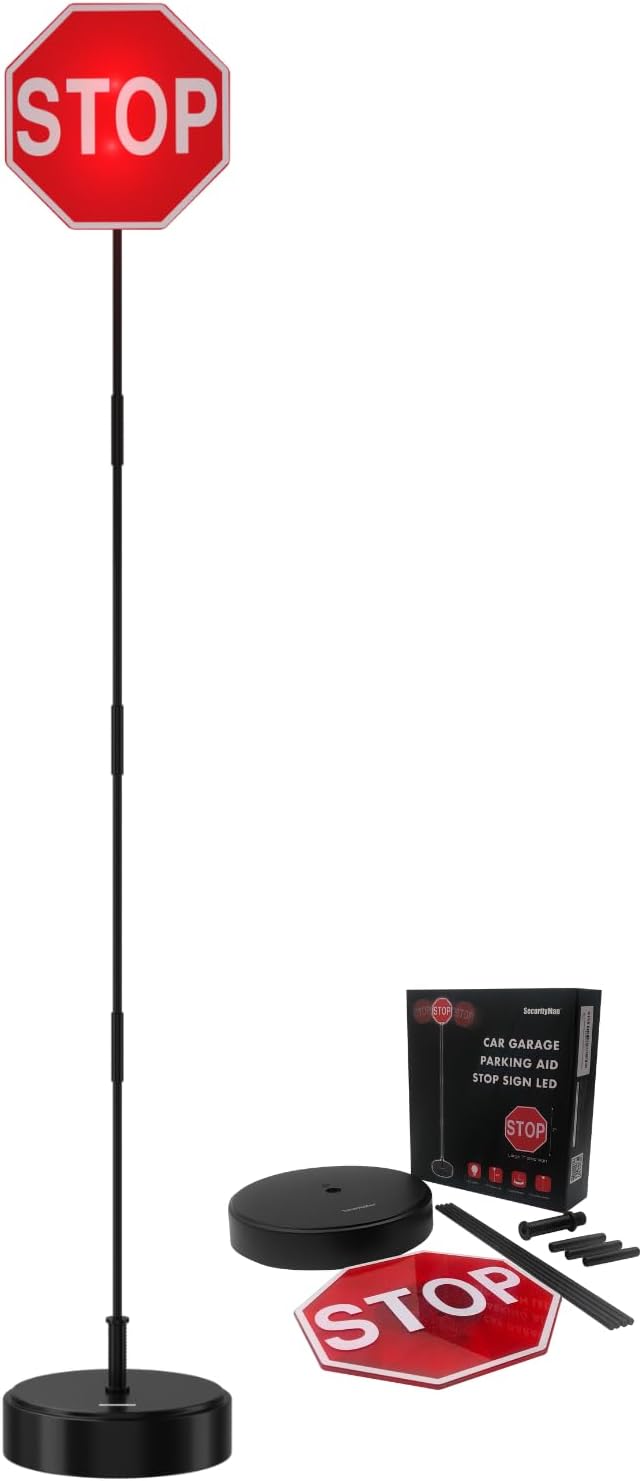
Why we picked it: The 7-inch LED sign face is the largest in this comparison, and the spring-connected pole absorbs bumper contact without the unit toppling. Batteries ship in the box — an advantage over rivals that arrive incomplete — and four 11-inch poles allow adjustment up to 55 inches for full-size trucks and SUVs.
| Brand | SECURITYMAN |
|---|---|
| Size | 7 inch |
| Color | Upgraded Base |
| Material | Plastic |
| Mounting Type | Pole Mount |
| Item Weight | 0.98 kg |
| Light Type | LED |
| Orientation | Portrait |
| Pre-printed | Letter |
| Product Dimensions | 11"L x 4"W |
At 55 inches maximum height, this is the tallest adjustable configuration in the LED stop-sign group, which matters most for high-hood vehicles like full-size trucks where a shorter sign sits below the natural sightline. The spring joint between pole sections is the design detail that makes contact-based guidance practical: the pole flexes when the bumper touches it, the LED fires, and no damage occurs to either the sign or the vehicle’s paint — the spring resets immediately. Four 11-inch segments stack to build that height, and buyers can remove segments to shorten the assembly for lower vehicles. The 7-inch LED sign is bright and octagonal, recognisable at a glance without reading the label. That the batteries ship inside the box matters practically: unlike several rivals in this category, you can set this up and use it the same day without a hardware-store trip. The weighted base is described as upgraded, and the pole mount is Pole Mount style rather than a split weighted base, which keeps the footprint tighter than dual-base designs. Floor-standing units do occupy usable floor space, and in a narrow single bay they can become a trip hazard for anyone moving between the car and a workbench. Single-pack pricing reflects mid-range positioning; households needing two signs pay double, making the TUMAX 2-pack the stronger value at scale.
Owner feedback patterns
Buyers of contact-triggered LED stop signs frequently praise the immediate visual feedback loop — touch the pole, sign lights, stop — as intuitive for every driver in the household; the base stability after repeated soft contact draws the most scepticism, with the category pattern on retail platforms showing a share of owners adding weight or adhesive tape to the base over time.
Who it’s for: SUV and full-size truck owners who need a tall, clearly visible floor indicator with batteries already included Skip it if: Skip if floor space is so tight that a free-standing pole would block access to the car's side doors. Use case: Tall vehicle in a single-car garage needing a contact-activated visual stop
TUMAX LED stop sign 2-pack — engineered rods for two-car garage duty

Why we picked it: Two complete LED stop-sign assemblies with an exclusively designed 5.2mm rod system resist the wobble and lean that plague thinner standard rods, and the ABS sleeve engineering directly addresses the shrinkage-and-loose-joint problem common in older floor-sign designs. Tool-free setup means no ceiling access needed.
| Brand | TUMAX |
|---|---|
| Color | Red |
| Mounting Type | Floor Standing |
| Light Type | LED |
| Recommended Uses For Product | Garage, Parking |
| Product Dimensions | 54"L x 54"W |
| Number of Pieces | 2 |
| Manufacturer | TUMAX |
| Number of Packs | 2 |
| Unit Count | 2 Count |
TUMAX publishes the rod diameter — 5.2mm, custom-moulded — where most rivals in this segment list nothing, and that specificity signals real engineering attention to a part that commonly fails in cheaper units. The ABS sleeves that connect rod segments are produced through precision moulds to prevent the material shrinkage that causes joint looseness over months of daily contact; that is a failure mode well documented in first-generation floor stop signs, and addressing it at the manufacturing stage matters more than any surface finish. Each unit’s LED flashes on gentle vehicle contact, so the alert fires before the bumper reaches full compression. Two complete assemblies in the box put this kit in direct competition with buying two single signs separately; the mid-range price point spreads across both units reasonably. Height adjusts to over 50 inches, which covers most passenger vehicles and crossovers though falls just short of the Securityman’s 55-inch ceiling for the tallest full-size trucks. Stability of the weighted base under repeated soft contact is the category trade-off that no floor-standing design fully solves; this unit addresses it with a heavier base, but placement on smooth epoxy-coated floors may still benefit from adhesive strips. A two-sign layout also commits more floor area than a single ceiling laser, which is relevant for anyone who stores equipment tightly around the vehicle.
Owner feedback patterns
Buyers of 2-pack LED sign kits typically cite the value-for-two-bays as the top purchase driver; within the floor-standing LED stop sign category on retail platforms, the most recurring concern is base shift on smooth or painted concrete floors after repeated use, and the TUMAX’s heavier base attempts to address that pattern directly.
Who it’s for: Two-car households who want floor-standing LED guidance with better-than-entry-level rod stability Skip it if: Skip if you have one parking bay; paying for a 2-pack when one sign is sufficient adds cost without benefit. Use case: Two-car garage needing upgraded floor-standing LED stop signs with structural rigidity
MAXSA Park Right mat — two-bump tactile feedback, no power required

Why we picked it: A two-stage tire bump — a small advance bump followed by a large stop bump — delivers tactile confirmation through the steering wheel with no power source, no ceiling access, and no pole in the lane. Rubberized plastic, 3M anti-skid tape, and a built-in drip tray combine three functions in one mat.
| Material | Rubber |
|---|---|
| Color | Black |
| Brand | Maxsa Innovations |
| Product Dimensions | 21"L x 11"W x 2"Th |
| Vehicle Service Type | Passenger Car, truck, RV, vans, anything with tires |
| Auto Part Position | Right |
| Fit Type | Universal Fit |
| Number of Items | 1 |
| UPC | 850004980170 |
| Number of Packs | 2 |
The drip tray is the detail that separates this mat from simple wheel stops: water, snow melt, and road dirt that would otherwise puddle on the garage floor collect in the mat’s body, keeping the floor surface cleaner between cleaning sessions. The two-bump feedback is a thoughtful sequence — the small first bump says you are on target, the large second bump says stop — which works for experienced and inexperienced drivers equally because it requires no visual reference at all. At 21 inches long, 11 inches wide, and 2 inches at the peak, the mat fits all passenger-vehicle tire widths the brand lists, including pickup trucks, minivans, and RVs. The 3M peel-off anti-skid tape secures the mat to the floor without drilling; Maxsa includes a 90-day limited warranty, which is the only formal warranty period in this comparison. The 2-inch second bump is also the clearest limitation: vehicles with a front air dam lower than 2 inches — certain sport coupes and lowered cars — risk scraping the plastic on entry or exit. Adhesive bond strength on smooth sealed floors depends on surface prep, and the brand’s instructions require a firmly pressed, clean dry surface; a quick press on a dusty floor will not hold reliably. The 2-pack covers two stalls, though at mid-range pricing this is not the lowest-cost floor stop option in the group.
Owner feedback patterns
Buyers of parking mats consistently praise the no-power, no-installation simplicity and the tactile feedback that works in complete darkness; the concern that surfaces most often in this product category on retail platforms is adhesive durability on painted or sealed concrete over repeated weekly use, with some owners supplementing the included tape after a season.
Who it’s for: Drivers who want a power-free, floor-level physical stop that also captures drip water from daily commuter vehicles Skip it if: Skip if your car's front air dam sits under 2 inches from the ground; the second bump will catch it on every approach. Use case: No-power floor stop with drip tray for standard passenger vehicles in a sealed garage
VKQTS LED wall sensor — traffic-light distance display on the rear wall

Why we picked it: A green-to-yellow-to-red LED display mounts to the rear wall and reads distance through a tethered sensor, with the warning threshold adjustable anywhere from 6 inches to 6.5 feet. Dual power — USB cable or AAA batteries — requires no hardwiring, and the 1-ounce sensor unit claims virtually no wall space.
| Manufacturer | VKQTS |
|---|---|
| Brand | VKQTS |
| Model | Garage Parking Sensor |
| Item Weight | 1 ounces |
| Product Dimensions | 4.63 x 3.5 x 1 inches |
| Item model number | Garage Parking Aid |
| Manufacturer Part Number | VKQTS-Bo Che Yi-1505 |
Mounting on the wall behind the vehicle keeps the entire floor lane clear — no pole to step around, no mat to negotiate with low-slung vehicles, no ceiling drill point. The colour sequence mirrors traffic-light logic: green for safe approach, yellow for caution, red to stop, so any driver interprets it immediately without instructions. The stop threshold is set by pressing the red button at the desired distance, and the brand states the adjustment range runs from 6 inches to 6.5 feet, which covers the spread between a compact car that stops tight to the bench and a long wheelbase truck that needs 2 feet of buffer. Dual power deserves emphasis: the USB cable option means you can run it from a garage outlet or a USB wall adapter; the AAA battery option removes the wire entirely for clean-looking installs on shelving or pegboard. Adhesive strips and screws both ship in the box. The first real limitation is that this is a purely visual aid — there is no physical contact element, so a driver who is not watching the wall display will gain nothing from it. The sensor cable runs 35.43 inches between the sensor and the display unit, which restricts placement options if the wall is farther from the parking position than that. The display unit itself is only 4.63 by 3.5 inches, which is notably smaller than a 7-inch LED stop sign; visibility from inside a tall SUV may require deliberate positioning at eye height.
Owner feedback patterns
Buyers of wall-mounted distance sensors tend to praise the unobstructed floor as the top benefit and the colour-code clarity as intuitive for every household member; the concern that appears across the broader wall-sensor category on retail platforms is sensor accuracy at the outer edge of the detection range, with some buyers reporting the red-light threshold drifting slightly after temperature swings in unheated garages.
Who it’s for: Garages where both floor space and ceiling access are limited and a visual-only wall cue is acceptable Skip it if: Skip if no one in the household reliably watches the rear wall while parking; a physical stop works for inattentive parkers in ways this sensor cannot. Use case: Wall-mounted distance display for tight garages with no floor or ceiling access
SARDVISA tennis ball 2-pack — non-elastic string keeps the stop point honest

Why we picked it: A braided nylon string that resists stretching over time is a genuine material upgrade over elastic cords that gradually shift the hanging position, and the spring adjustment buckle makes height resetting quick without re-threading the ceiling hook. Two fluorescent yellow balls at a budget price cover both a driver and passenger side.
| Manufacturer | SARDVISA |
|---|---|
| Brand | SARDVISA |
| Model | Tennis Ball Garage Parking Aid |
| Item Weight | 7.8 ounces |
| Package Dimensions | 5.2 x 3.98 x 2.52 inches |
| Item model number | A4171 |
| Manufacturer Part Number | 4171 |
Non-elastic cord is the SARDVISA’s single most important differentiator: elastic strings are common in tennis-ball parking guides, and they drift measurably over months of daily contact, eventually putting the ball an inch or two beyond the original calibration point. A 13-foot braided nylon string does not stretch, so once the spring buckle is set, that height stays. The spring adjustment buckle also matters — conventional sliding knots loosen under vibration, while a buckle holds and can be reset by hand without tools when the car changes or the ideal stopping position shifts. Fluorescent yellow is visible even in the low-contrast light of a closed garage, and two balls in the pack let you hang one for each bay or one each for driver and passenger reference. Installation requires marking the ideal stop position, drilling one screw hook into the ceiling, and threading the string; the included manual walks through each step. The 13-foot total string length is the hard constraint: in garages with a ceiling height beyond the typical 7- to 8-foot residential range, that length may not leave enough hanging slack to reach windshield height, and buyers should measure before ordering. This is also a contact-only visual cue — it touches the windshield glass, not the bumper, so it gives no electronic alert, no flashing confirmation, and no feedback if the ball swings aside and the car passes beneath it unnoticed.
Owner feedback patterns
Buyers of tennis-ball ceiling aids broadly appreciate the simplicity and the near-zero cost versus electronic alternatives; the most consistent friction point across this product type is the re-calibration required when a different vehicle uses the same bay, since height adjustment — even with a buckle — takes a minute or two, and families with multiple vehicles of different sizes find this repetitive.
Who it’s for: New drivers or single-vehicle households wanting a simple, low-cost visual depth cue that needs no power Skip it if: Skip if your ceiling height exceeds 13 feet or if two drivers with vehicles of different hood heights share the same stall and cannot agree on a single stop point. Use case: Budget ceiling-hung parking depth indicator for standard residential garages
Stalwart parking mat — renter-friendly peel-and-stick floor stop

Why we picked it: Peel-and-stick installation with no drilling makes this the only floor stop in the group that leaves no permanent mark, and the 1.8-inch profile is low enough for most vehicles to clear without scraping. Yellow-striped molded hardened plastic is visible even partially hidden beneath a tyre.
| Manufacturer | Trademark Global |
|---|---|
| Brand | Stalwart |
| Model | Garage Parking Aid |
| Item Weight | 3.21 pounds |
| Package Dimensions | 16.54 x 6.77 x 2.05 inches |
| Item model number | 75-CAR2018 |
| Manufacturer Part Number | 75-CAR2018 |
At 1.8 inches tall, this is the lowest-profile physical wheel stop in the comparison, which means more low-clearance vehicles can roll over the leading edge without catching the front valance — the MAXSA mat’s 2-inch second bump is the closest rival, and those two extra tenths of an inch make a real difference for sport coupes or lowered sedans. Yellow high-visibility stripes run the full 16-inch length of each stopper, so the mat remains visible from the driver’s position in the seat even before the wheel touches it. The peel-and-stick base relies on adhesive contact between the plastic underside and the floor surface; on smooth sealed or epoxy-coated concrete the hold is firm, but a dusty, oily, or rough uncoated floor will reduce adhesion noticeably, and the brand’s instructions implicitly require a clean, flat surface. At 3.At roughly 3.21 pounds for the 2-pack, each individual stop is light enough to shift if adhesion fails, particularly under repeated heavy-vehicle contact. The 2-pack covers both front tyres of one vehicle. This is a passive stop with no electronic component, no power source, and no alert signal, which is precisely the point for buyers who want simplicity — but it also provides no warning before contact, so drivers who pull in quickly may still bump the wall before learning where the mat sits. For renters who cannot drill, this is essentially the only floor-level physical option in the group that leaves no trace on lease return.
Owner feedback patterns
Buyers drawn to peel-and-stick wheel stops tend to praise the zero-tool installation and the clean removal that protects a rental garage floor; the category pattern across retail platforms shows that adhesive bond longevity on unsealed or painted concrete is the most common concern, with buyers on smooth-finished floors reporting better long-term hold than those on bare aggregate.
Who it’s for: Renters or owners who cannot drill the garage floor and need a low-profile physical stop for standard passenger vehicles Skip it if: Skip if your floor is unsealed aggregate concrete or if you park a vehicle over 5,000 lbs; adhesive hold under repeated heavy-load contact is not guaranteed. Use case: Renter-friendly peel-and-stick floor stop for standard passenger vehicles
Cobra Tuning LED stop sign — most portable floor sign for changing locations

Why we picked it: Four assembly sections reach 53 inches, and two weighted bases can join together for extra stability or separate for compact storage; the whole unit breaks down in minutes. It is the pick for anyone who needs to move a floor-standing LED signal between a home garage, a driveway, and a temporary parking bay.
| Brand | Cobra Tuning |
|---|---|
| Size | Large Signage |
| Color | black |
| Material | Plastic |
| Mounting Type | Floor Standing |
| Item Weight | 0.51 kg |
| Light Type | LED |
| Orientation | Portrait |
| Pre-printed | Letter |
| Product Dimensions | 53"L x 53"W |
The dual-base design is the structural feature that distinguishes this from single-base rivals: each base is weighted independently, and the two can be fixed together when maximum stability is needed or used separately to weight the assembly at two points. That joinable-base approach is particularly useful on uneven or slightly sloped driveways where a single central base would rock. The four-section pole reaches 53 inches assembled, two inches shorter than the Securityman’s 55-inch ceiling and notably shorter than what full-size trucks with high door sills need for a clear sightline from the seat; shorter vehicle owners and compact-car households will find 53 inches adequate. Two alternating-flash LED lights inside the sign fire when the flexible rod takes bumper contact, and the portability of the whole assembly means those flashing lights can follow you to a driveway, a storage unit bay, or a friend’s garage with no reinstallation effort. The sign face itself is not dimension-specified in the brand’s listing — Cobra Tuning does not publish a face diameter as SECURITYMAN does for its 7-inch sign — which makes direct visibility comparison difficult and is a transparency gap worth noting. Build quality, inferred from the 0.51 kg total weight, is lighter than the Securityman’s 0.98 kg, suggesting a thinner plastic spec throughout. For a permanent single-garage installation where visibility and stability matter most, the Securityman edges ahead; Cobra Tuning earns its place for buyers who value portability above fixed-location performance.
Owner feedback patterns
Buyers of portable LED stop signs cite the take-anywhere flexibility as the primary appeal; across the floor-standing LED sign category on retail platforms, lightweight units like this one attract comment about base stability on smooth surfaces, with the most common workaround being the addition of a rubber mat under the weighted base to increase friction on polished concrete.
Who it’s for: Buyers who need a floor-standing LED contact signal they can move between multiple parking locations Skip it if: Skip if you park a tall SUV or full-size truck and need a sign visible above the steering wheel; at 53 inches the assembly may sit below the natural sightline. Use case: Portable LED stop sign for multi-location or temporary parking needs
What to check before you buy a garage parking aid
- Ceiling access: Laser and tennis-ball aids require drilling into joists or drywall; confirm you can reach the installation point before ordering.
- Power availability: Floor-standing LED signs and wall sensors need an outlet or batteries; identify the nearest outlet to the parking position before choosing a wired model.
- Vehicle height: Adjustable LED stop signs top out between 50 and 55 inches; a full-size truck driver in a raised cab needs every inch of that range to see the sign clearly from the seat.
- Floor clearance: The MAXSA mat’s 2-inch second bump is the tallest floor obstacle here; vehicles with a front air dam below that height will scrape on approach.
- Number of bays: Two-car garages justify a 2-pack kit or a dual-laser unit; a single-bay household pays a premium for capacity it will never use.
- Tenancy: Only peel-and-stick mats and tool-free floor signs can be fully removed without trace; renters should rule out all ceiling- and floor-drilled options before shortlisting.
- Physical vs. visual stop: Visual aids (lasers, wall sensors) rely on the driver watching; physical stops (mats, wheel stops) work regardless of attention, which matters in households with new or distracted drivers.
How to keep your parking aid working for the long term
Ceiling-mounted laser units accumulate dust on the lens over months of garage use, which diffuses the beam and shortens detection range. A dry microfibre cloth across the lens face once a season restores output without risking moisture damage to the housing. Check that ceiling adhesive mounts have not loosened after the first winter; thermal cycling between cold nights and warm days causes adhesive bonds to relax, and an 11-ounce unit dropping from the ceiling can damage whatever is beneath it.
Floor-standing LED signs benefit from periodic inspection of the rod joints and sleeve connections, particularly at the start of a season after temperature extremes — the ABS sleeve engineering in the TUMAX addresses material shrinkage, but older or budget units should have joints hand-tightened every few months. Weighted bases on smooth epoxy floors tend to creep over time under repeated soft contact; a strip of non-slip rubber mat beneath the base adds meaningful grip without permanent modification.
Adhesive floor mats — the Stalwart wheel stop and the MAXSA Park Right — should have their tape bond checked after the first month of use, and any edge lift re-pressed immediately before a tyre rolls over the loose section and peels the whole mat back. The MAXSA’s 90-day limited warranty is the only formal manufacturer commitment in this comparison; keep the receipt.
What owners praise and question most across this category
Across retail platforms, the most consistently praised aspect of garage parking aids is installation simplicity — the ease of getting a unit placed and functional on the same day it arrives. This is the dominant positive pattern for every format: ceiling lasers, floor signs, mats, and wall sensors all attract comment about how quickly the first setup completes. The second most praised element is the confidence benefit: owners across categories describe reduced anxiety for new drivers and for anyone regularly parking in a tight single-car garage.
The most common complaint pattern, appearing across all floor-standing LED sign formats, is base stability under repeated soft contact — specifically on smooth, sealed, or painted concrete where friction is low. This complaint is proportionally higher for lighter single-base units and lower for heavier dual-base or upgraded-base designs, which is reflected in the rankings here. For ceiling-mounted lasers, the recurring friction point is the initial calibration process: getting both beams or a single dot aimed at a consistent reference mark takes more trial-and-error than the installation instructions suggest, and the concern re-surfaces whenever the mount is disturbed.
For adhesive floor products — mats and peel-and-stick wheel stops — the main question raised is long-term adhesive bond strength on unsealed or dusty concrete. Owners on sealed or epoxy-coated garage floors report significantly more durable hold than those on bare aggregate, suggesting surface preparation before application is the single most influential variable in long-term performance for that product type.
What to skip
- Reswish LED Light Parking Stop Sign: Duplicates the floor-standing LED stop sign format of multiple picks already in the list while publishing fewer structural specs — rod diameter, base weight, and maximum height are not stated — than the TUMAX or Securityman alternatives at a comparable price band.
How this guide was researched
No product in this guide was handled by Repack Mechanics; every pick is based on published listing specifications, manufacturer feature claims, and aggregated owner-feedback patterns from retail platforms. Laser safety classifications were cross-referenced against ANSI Z136.1 (the American National Standard for Safe Use of Lasers) and IEC 60825-1 (the international equivalent) to verify the Class IIIA designation stated for the MAXSA 37310. Floor-mat height specifications were reviewed against typical front air-dam clearance ranges for passenger vehicles, using data published by vehicle manufacturers in owner manuals. Adhesive product claims were reviewed in the context of CPSC general consumer product guidance on adhesive bond durability. Owner-feedback patterns are described as category tendencies — base stability, calibration difficulty, adhesive durability — without quoting individual reports; approximate pattern frequency is stated where the volume of reports on a given platform supports that characterisation. The Reswish LED stop sign was cut because its published specification detail is materially thinner than the alternatives it would directly compete with, making a fair structural comparison impossible.
Produced by Garage Ceiling Storage Editorial responsibility: Repack Mechanics.
Answers before you buy
What does 'Class IIIA laser' mean on a garage parking guide?
Class IIIA is the laser safety classification defined in ANSI Z136.1 and the equivalent IEC 60825-1 international standard. It covers lasers with output between 1 and 5 milliwatts — the same range as a presentation pointer. For a garage parking guide, it means the beam is safe for brief, incidental eye exposure during a normal approach, though deliberately staring into the dot is still inadvisable. The MAXSA 37310 is the only product in this comparison that explicitly states its Class IIIA rating.
Why does motion activation matter for a ceiling-mounted laser?
A continuously-on laser dims the diode faster and wastes electricity; motion activation extends diode life and cuts idle power draw to near zero. The Fosmon unit detects movement at up to 33 feet and shuts off 30 seconds after motion stops, while the MAXSA 37310 uses a 130-degree detection arc and a 15-second shutoff. The practical effect is that the laser fires as the car enters and extinguishes well before the door closes, so the diode is only active for 30–60 seconds per parking event rather than all day.
What is a spring-connected pole and why does it prevent bumper damage?
A spring-connected pole — used in the Securityman and Cobra Tuning LED stop signs — has a flexible joint between the weighted base and the rigid upper sections. When a vehicle bumper makes soft contact, the pole deflects rather than transferring the full force to the base or the bumper. The LED fires on that deflection, then the spring resets the pole upright. Without the spring joint, repeated contact would either topple the unit or place consistent point pressure on the bumper’s painted surface, risking scuffs over time.
What is the difference between a parking mat and a wheel stop for a garage?
A wheel stop is a single profile barrier that halts tire travel; a parking mat is a larger platform that the entire tire rolls onto, with a built-in stop bump at the far end. The MAXSA Park Right mat (21 by 11 inches, 2-inch peak) uses two sequential bumps — a small advance bump and a full stop bump — to give staged tactile feedback through the steering wheel. A simple wheel stop, like the Stalwart at 16 inches long and 1.8 inches high, provides a single hard stop. Mats also often double as drip trays; wheel stops do not.
What does 'dual power' mean on a garage parking sensor, and which setups benefit from it?
Dual power means the device accepts two independent power sources — typically USB mains and AAA batteries — and the user chooses which to use at install time. The VKQTS LED wall sensor supports both a USB cable (76.77-inch charging cable included) and AAA batteries (not included). Garages with a wall outlet near the sensor benefit from USB for uninterrupted operation; garages with no nearby outlet, or owners who want a fully wire-free look, use batteries. Neither option requires hardwiring or an electrician.
So which one?
For a two-car household pulling into a dark garage every night, the Fosmon dual laser is the coherent answer: two beams, one mount, battery backup, and a budget price. The one case where a different pick wins is the renter with a single bay and no ceiling access — the Stalwart peel-and-stick mat is the only option that leaves no mark and still provides a real physical stop. The one reason to skip the category altogether is if your garage layout changes seasonally with equipment storage; any fixed-reference parking aid becomes wrong the moment the reference point moves, and re-calibration, however quick, is an ongoing task.
How this guide was made
Editorial responsibility: Repack Mechanics.
What changed
- Published guide
- Guide drafted